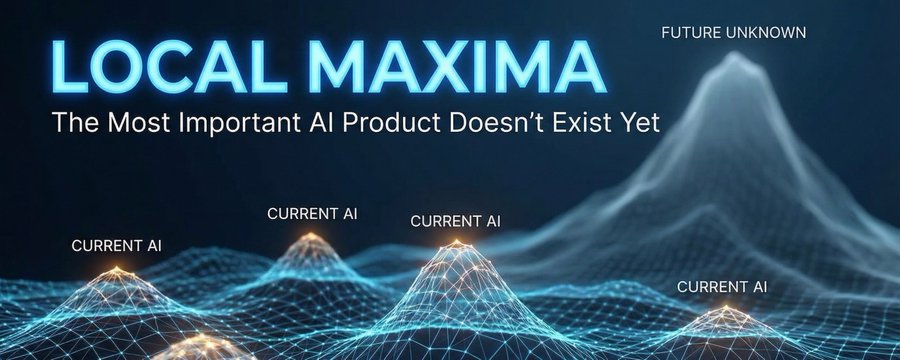
Most of the AI products you're excited about right now are Segways. Technically impressive. Enthusiastically funded. Solving a problem nobody will frame the same way in five years.
There's a concept in mathematics called a "local maximum." The highest point in your immediate vicinity, but only because you haven't zoomed out enough to see the mountain behind you. When the ground is shifting fast, the pressure to ship something pushes every builder toward the nearest peak. Not the tallest one. The nearest one.
That's the entire AI industry right now.
Sora generates stunning video. And it's optimizing for a version of "content creation" that was defined before AI existed. Stitching clips, editing timelines, producing polished output. It assumes the artifact is still a video. What if the thing that replaces video doesn't look like video at all? Nobody's asking that question because Sora looks like progress. It is progress. It's just not the progress.
Perplexity rebuilt search with citations and clean answers. Better than ten blue links, absolutely. But it's still you asking a question and reading a response. A better answer machine. The real shift will be something that eliminates the need to ask in the first place. Perplexity made the horse faster. Someone else is going to invent the car.
Mistral, LLaMA, the whole open-weight model race: faster, cheaper, more accessible LLMs. Useful work. But the transformer architecture is twelve years old. Everyone is optimizing the engine of a vehicle whose chassis hasn't been questioned yet. The foundational breakthrough that changes everything is probably not a better transformer.
It's the pattern every single time.
MapQuest was a local maximum. It digitized paper maps. Then GPS-enabled phones changed the question entirely, from "show me directions" to "guide me in real time, right now, while I'm moving." Blackberry perfected mobile email. Then the iPhone redefined what a phone was for. Clubhouse was the future of social audio for about four months. Vine had short-form video before TikTok but lacked the algorithm that made the format matter. Every one of these products was genuinely good. Every one optimized the right variable at the wrong altitude.
Here's the uncomfortable truth nobody building these tools wants to hear: when the environment is shifting beneath your feet, the most legible improvements, the ones that feel like obvious progress, are almost always lateral moves along the current landscape. Not the leap to a new one. The leap never feels like optimization. It feels like a weird left turn that only makes sense in retrospect.
The AI products that will genuinely reshape daily life for billions of people probably don't have breathless launch threads yet. They might not even be recognizable as "AI products." The smartphone wasn't marketed as a "better PDA." Google wasn't sold as a "better directory." The thing that changes everything never announces itself in the language of the thing it replaces.
Zoom out. The gold rush is loud but the landscape is still forming. The most important summit on this mountain range hasn't been spotted yet.