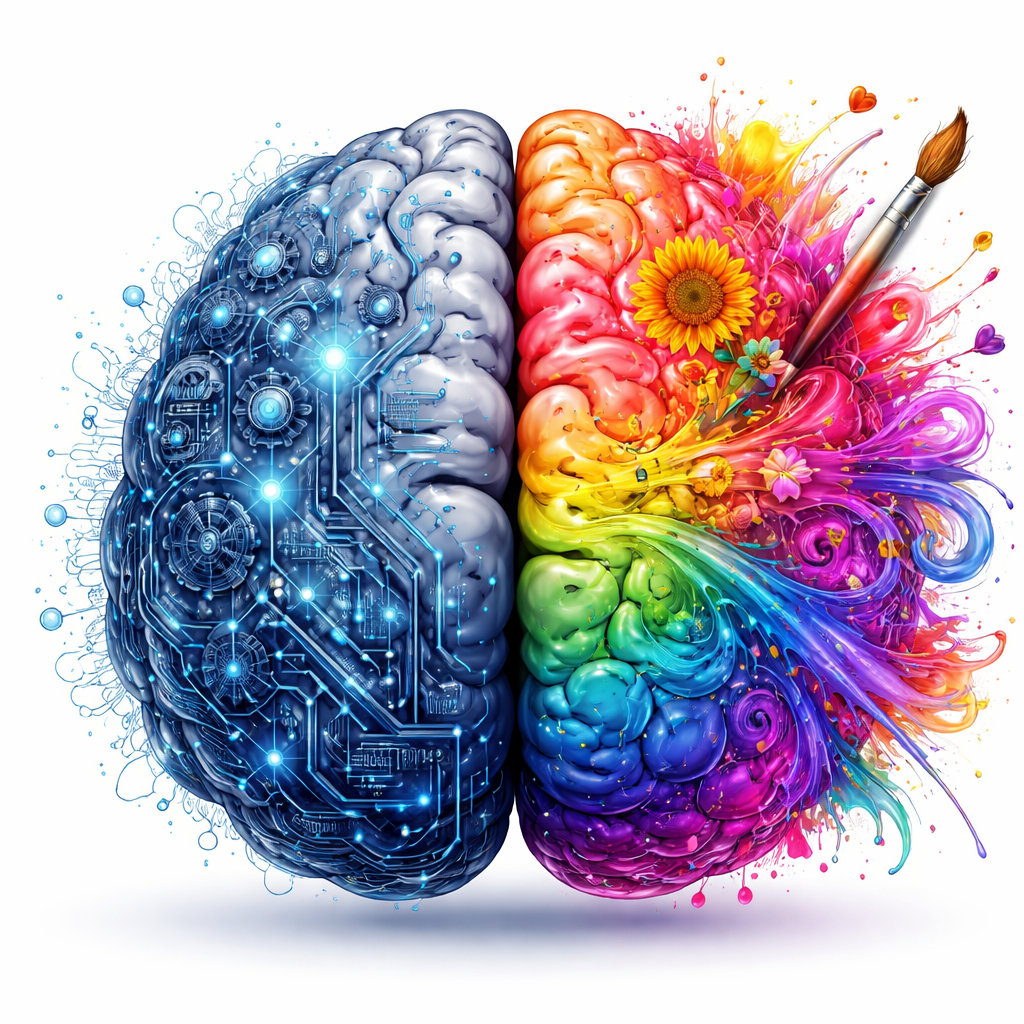
The division of the human brain into left and right hemispheres, and their functional specialization, is widely treated as a fundamental feature of intelligence. We argue it is not. Hemispheric lateralization is a downstream consequence of bilateral body symmetry, which evolved under locomotion pressure approximately 550 million years ago. The brain didn't split because cognition required two modes. The body split because movement required symmetry, and the brain, embedded in that body, followed. Evolution then optimized the redundancy this created, producing lateralized specialization as a metabolic efficiency measure. This distinction matters for the design of digital intelligence, where no bilateral body plan exists and no such constraint applies. We identify which cognitive properties attributed to lateralization are genuinely fundamental, and which are artifacts of having a brain that is two halves because everything is two halves.
1. The Body Split First
The standard pop-science account runs roughly: the brain has two hemispheres because cognition benefits from two complementary processing modes, one analytical, one holistic. This gets the causation backwards.
Bilateral symmetry in animals arose in early bilaterian worms during the Cambrian, driven by locomotion. Radial symmetry serves organisms that sit in place and let the world come to them: jellyfish, anemones. But once an organism moves through an environment in a consistent direction, it benefits from having a front and a back, a left and a right. Streamlined movement, balanced mechanical forces, paired sensory organs that can triangulate. The body plan split into mirror halves because physics favored it.
The nervous system, developing within this body plan, inherited the symmetry. Two eyes, two ears, two arms, two kidneys, two brain hemispheres. At its most basic level, the brain's bilateral structure is not a cognitive optimization. It is a developmental consequence of the body it grew inside.
2. Redundancy Creates Pressure
Two hemispheres processing identical information in identical ways is expensive. The brain consumes roughly 20% of metabolic budget for 2% of body mass. Running two identical processors is a luxury evolution does not tolerate for long.
So lateralization emerged, not because cognition requires two modes, but because having two hemispheres permits specialization, and metabolic pressure demands it. This is an optimization of an existing architecture, not a first-principles design. Lateralization effectively doubles computational diversity without doubling hardware. Instead of two hemispheres doing the same thing and checking each other's work, you get two hemispheres doing complementary things and integrating their outputs. One narrows attention, the other broadens it. One categorizes, the other contextualizes.
The result is powerful. But the reason it exists is that evolution was handed two hemispheres by the body plan and had to justify the expense.
3. The Predator-Prey Kludge
Comparative biology reveals the survival pressure that shaped lateralization most directly: the simultaneous need to forage and avoid being eaten.
Many bird species use their left eye (right hemisphere) for broad vigilant scanning, watching for predators, while using their right eye (left hemisphere) for focused tasks like pecking at specific seeds. Fish, amphibians, and insects show analogous patterns. The two attentional modes, broad contextual awareness and narrow focused manipulation, aren't abstract cognitive preferences. They are survival necessities that must operate simultaneously, and having two pre-existing hemispheres made simultaneous operation possible.
In highly social species, lateralization intensifies further, because social environments demand both modes at maximum capacity: focused attention on the individual you're interacting with, broad awareness of group dynamics and threats.
This is elegant. It is also entirely contingent on having a bilateral body navigating a physical environment with predators. Remove the body, and the evolutionary pressure that sculpted lateralization vanishes.
4. Contralateral Wiring: The Inherited Quirk
Each hemisphere primarily controls the opposite side of the body. This contralateral organization is ancient and not fully explained. The leading hypothesis involves the optic chiasm in early vertebrates, where visual crossing allowed each hemisphere to coordinate a complete sensorimotor loop (see left, respond right) with minimal delay. Once crossed wiring was established for vision and motor control, everything else followed, locked in by developmental constraint.
This is worth emphasizing: one of the most fundamental organizational features of the human brain, contralateral control, exists because of how early vertebrate eyes connected to early vertebrate motor systems. It is a frozen accident of evolutionary plumbing, not a computational principle.
5. Why Not Three Hemispheres?
If two complementary modes are better than one, why not three or four? Partly because bilateral symmetry constrains to two. Evolving a third hemisphere would require radical developmental reorganization. But there may be a deeper reason, and it cuts against our thesis in an interesting way.
Two modes may approximate an optimal decomposition of how any agent relates to its environment: one system that simplifies and controls, one that remains open and receptive. These may be the two irreducible poles of agency. A third mode might not represent a genuinely new kind of processing.
We note this argument but remain skeptical. The "two irreducible poles" framing may itself be an artifact of theorizing from within a bilateral cognitive architecture. A system that never had two hemispheres might decompose the problem differently, or might not decompose it at all.
6. What Lateralization Actually Is (and Isn't)
The popular version (left brain logical, right brain creative) is largely wrong. Both hemispheres perform both kinds of work. What is actually lateralized is mode of attention and representation, not content domain.
Drawing on McGilchrist's synthesis and underlying neuroscience: the left hemisphere tends toward narrow, focused, sequential processing, including categories, labels, explicit representations, and certainty. It pins fluid reality into fixed schemas. The right hemisphere tends toward broad, contextual, relational processing, including novelty, ambiguity, metaphor, and gestalt. It grasps wholes before they have been analyzed into parts.
In healthy cognition these operate in dynamic cycle: the right hemisphere encounters something in full contextual richness, the left hemisphere analyzes and categorizes it, the right hemisphere reintegrates the analysis back into broader context, catching what the narrowing missed.
This cycle is genuinely valuable. The question is whether it requires two physical hemispheres, or whether it is a processing pattern that can be implemented in any architecture, including one that has no bilateral structure at all.
7. The Transformer as a Left Hemisphere
Current large language models are, in lateralization terms, overwhelmingly left-hemispheric. They operate on tokenized, sequential, decontextualized representations. They excel at categorical reasoning, pattern matching against known schemas, and generating fluent text within established structures. The transformer architecture is essentially a formalization of left-hemispheric processing: sequential attention over discrete symbols, optimized for prediction within learned patterns.
What transformers struggle with maps onto right-hemispheric functions: genuine novelty detection, holistic pattern recognition that resists decomposition, sensitivity to what is not being said, comfort with irreducible ambiguity, the ability to hold a representation loosely rather than committing to a fixed interpretation.
This observation has led some researchers (including ourselves, in earlier work) to propose building explicit lateralization into artificial systems: dual processing streams with different architectures, connected by a "corpus callosum" gating mechanism.
We now believe this impulse, while understandable, is a category error. It mistakes an evolutionary artifact for a design requirement.
8. The Actual Requirements
When we strip away the bilateral body plan and ask what cognitive properties are genuinely necessary, not because biology has them, but because the information-processing problem demands them, we find a shorter list:
Dual learning rates. A system that learns fast forgets fast (plastic but unstable). A system that retains well learns slowly (stable but rigid). This is the stability-plasticity dilemma, and it requires two complementary learning mechanisms regardless of physical architecture. In biology: hippocampus (fast) and neocortex (slow). In our system: MEMIT (fast) and LoRA (slow). This has nothing to do with left and right. It has to do with the mathematics of learning in a finite-capacity substrate.
Offline consolidation. Transfer from the fast system to the slow system cannot happen while the system is simultaneously processing new input. The weight modifications would produce incoherent outputs. This forces an offline phase. In biology: sleep. In digital systems: a maintenance window. Again, no hemispheres required.
Triage before repair. You cannot refresh everything. It is too expensive and healthy memories do not need it. An assessment step must precede a repair step. This is a resource-allocation constraint, not an architectural one.
Integrity verification. After heavy modification, coherence must be checked. This requires brief "awakenings," moments where the system surfaces enough to ask "am I still functioning?" before continuing. This is a quality-control requirement independent of bilateral structure.
These four requirements are forced by the problem of maintaining growing memories in a fixed-capacity substrate. They emerge from information theory, not from anatomy. Any system solving this problem, biological or digital, bilateral or unified, will converge on them. This is why our sleep-wake architecture converged on the same temporal structure as mammalian sleep without ever implementing hemispheric division: the constraints are the same, and they have one solution shape.
9. What We Don't Need
A digital intelligence does not need:
- Two physical processing streams. The analytical/holistic distinction can be implemented as temporal phases within a single system rather than spatial separation across two substrates. Our system already does this: MEMIT provides fast, precise, format-specific encoding (the "left-hemispheric" function), and LoRA provides slow, distributed, context-general integration (the "right-hemispheric" function). These are not two hemispheres. They are two passes through the same weights.
- A corpus callosum. The bandwidth-limited bridge between hemispheres exists because the hemispheres are physically separate and cannot share all information in real time. A unified digital system has no such bottleneck. The sleep cycle itself serves as the integration mechanism. MEMIT-encoded facts are replayed into LoRA training, achieving the same transfer that callosal communication provides, without requiring a separate bridge.
- Contralateral wiring. This is purely a consequence of vertebrate optic anatomy and has no computational analogue in digital systems.
- Predator-prey attentional splitting. The simultaneous need for broad vigilance and narrow focus, the evolutionary pressure that most directly shaped lateralization, does not apply to a system that is not navigating a physical environment with threats.
10. The Seductive Error
The deepest risk in brain-inspired AI is over-faithful mimicry: copying the implementation when you should be copying the function. Biology is full of solutions that are brilliant responses to constraints that digital systems simply do not face.
Wings evolved independently in birds, bats, and insects, not because they copied each other, but because the physics of flight has one solution shape. But feathers are not required for flight. They evolved for thermoregulation and were repurposed for aerodynamics. An engineer who studied birds and concluded that flight requires feathers would be making the same category error as an AI researcher who studies brains and concludes that intelligence requires hemispheric lateralization.
The bilateral brain is biology's feather. It works brilliantly. It was arrived at by accident: the body split, the brain followed, evolution optimized the result. It is not the only way, and for systems without bilateral bodies, it is almost certainly not the best way.
11. What Remains
Strip away the bilateral distraction, and what remains is this: robust lifelong learning requires dual timescales of memory, offline consolidation, and integrity-preserving maintenance. These are the aerodynamics of intelligence, the principles that hold regardless of substrate. Hemispheric lateralization is the feather, a specific, contingent, substrate-dependent implementation that evolution found because the body plan happened to provide two hemispheres and metabolic pressure demanded they justify their cost.
Digital intelligence is free to find its own implementation. It already is.